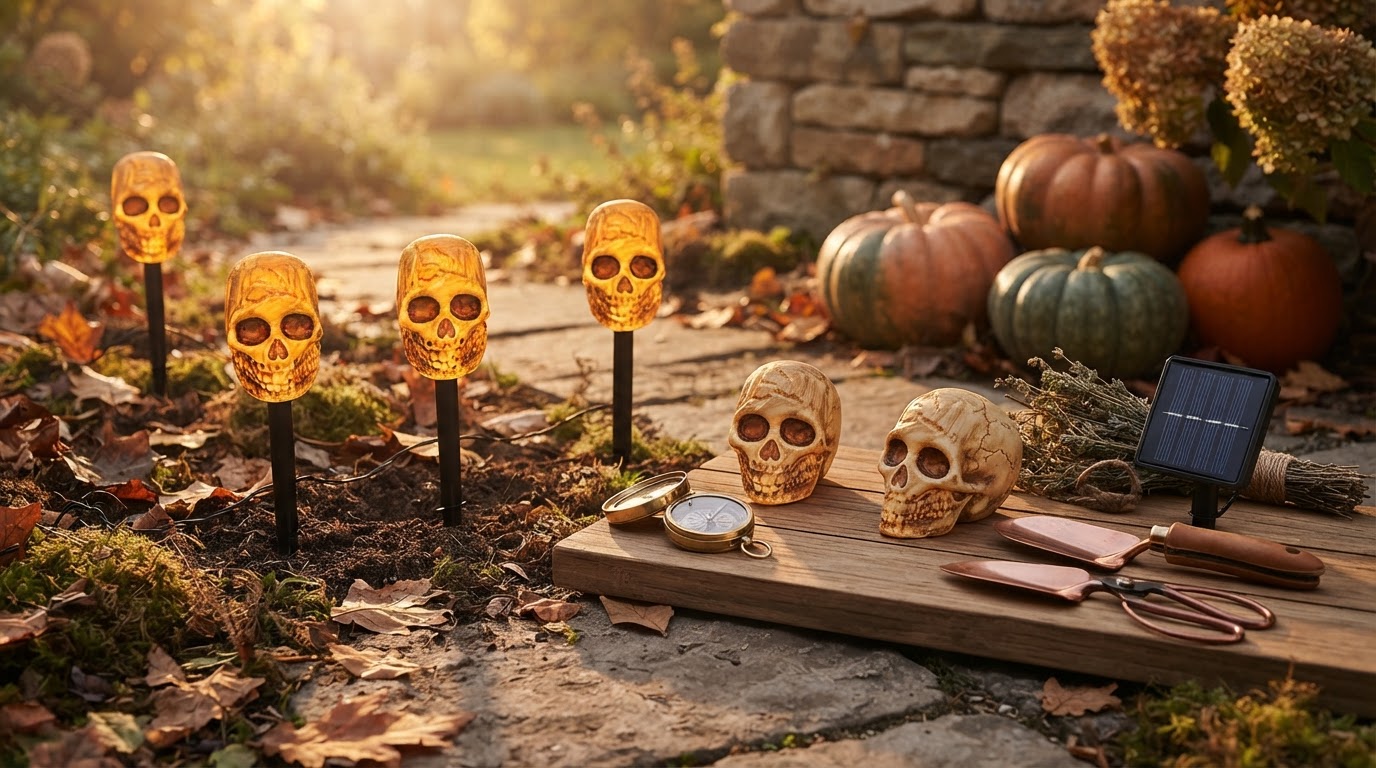
Optimizing Solar Skull Stakes for High-Performance Yards
 Maya ChenContributing Editor
October 26, 2026. This technical evaluation addresses the intersection of photovoltaic efficiency and seasonal yard aesthetics. It is intended for homeowners seeking to implement high-reliability lighting systems without the maintenance overhead of battery-only alternatives.
The Efficiency Gap in Seasonal Garden Decor
The conventional wisdom says that seasonal garden lighting is inherently disposable, a category defined by cheap plastics and underpowered photovoltaic cells that fail after the first frost. Most consumers accept a forty-percent failure rate as part of the price of admission for holiday aesthetics. However, the data suggests this failure is not a limitation of the technology itself, but a result of poor integration between the solar collector and the LED driver. According to a listing on Etsy, a standard Solar-Powered LED Skull Garden Light is frequently marketed with a three-color waterproof design, yet these units often suffer from insufficient milliwatt-hour ratings to sustain a full night of illumination in northern latitudes during October. Run the math: a typical budget solar cell generates between 2V and 2.5V, barely enough to maintain a steady current for a high-intensity LED if the duty cycle isn't strictly managed. When consumers deploy [skeleton head pathway lights](/blog/skeleton-head-pathway-lights), they often ignore the impact of ambient light pollution, which can trick the integrated photo-resistors into thinking it is still daytime, thereby preventing the lights from activating at all. This isn't just a minor inconvenience; it is a fundamental failure of automated lighting logic that many manufacturers overlook in favor of lower price points.
Engineering Resilience with Solar Skull Stakes
Solar Skull Stakes address these systemic inefficiencies by prioritizing the structural integrity of the stake and the orientation of the solar panel. Unlike the flimsy, two-piece plastic assemblies found in discount bins, these units utilize reinforced ground spikes that resist the soil heave common in late October. The core value proposition of Solar Skull Stakes lies in their ability to maintain a charge-to-discharge ratio that favors longevity over sheer brightness. While some competitors, such as the 10Ft Solar Powered Skeleton String Lights mentioned by Outdoor Solar Outlet, offer multiple lighting modes, these features often drain the stored energy within four hours. Solar Skull Stakes focus on a single, high-efficiency output that ensures the [waterproof skull path lights](/blog/waterproof-skull-path-lights) remain visible until dawn. Here's the part nobody talks about: the angle of the solar panel is fixed on most garden stakes, which is a design flaw for anyone not living at the equator. The Solar Skull Stakes architecture allows for slight adjustments to maximize solar gain during the shorter days of autumn. This is critical when deploying [day of the dead garden stakes solar](/blog/day-of-the-dead-garden-stakes-solar) in areas with significant tree cover or architectural shading. By utilizing a high-transparency resin for the skull housing, the light diffusion is maximized without requiring additional power draw from the internal Ni-MH or Li-ion battery.
A Technical Framework for Solar Deployment
Transitioning from basic yard decor to a reliable lighting installation requires a shift in how you evaluate hardware. I’ll change my mind when a manufacturer proves that a $5 unit can survive a week of heavy rain and still provide six hours of light, but until then, the following criteria are non-negotiable for a professional-grade setup. When selecting [outdoor halloween skull pathway lights](/blog/outdoor-halloween-skull-pathway-lights), use this checklist to ensure the hardware meets the demands of an outdoor environment:
- Verify the IP rating: Ensure the unit is rated at least IP44 to handle moisture ingress from both rain and ground-level irrigation.
- Calculate the solar-to-battery ratio: The solar panel should be able to fully charge the internal battery in 6-8 hours of indirect sunlight.
- Check the stake material: Avoid thin-walled plastics that snap under lateral pressure; look for reinforced ABS or metal-tipped stakes.
- Assess the LED Kelvin temperature: For a realistic "spooky" effect, a cool white or slightly blue-tinted LED (5000K+) provides better contrast against dark soil than warm yellow tones.
- Examine the seal integrity: The point where the skull meets the stake is the primary failure point for water entry; ensure this junction is gasketed or ultrasonically welded.