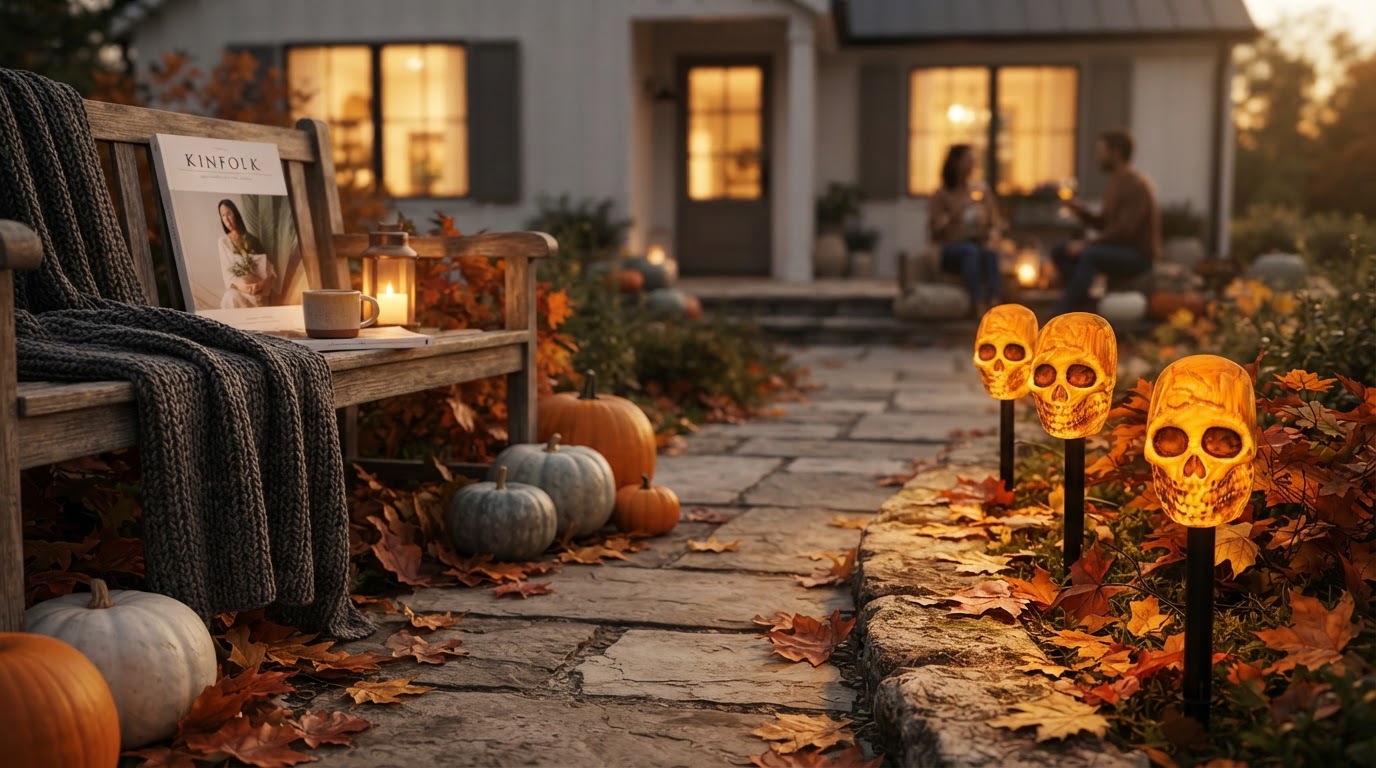
Solar Skull Stakes for Halloween Pathway Illumination
 Maya ChenContributing Editor
September 6, 2026. This analysis examines the functional utility of Solar Skull Stakes for residential walkways during the autumn season. It is intended for homeowners seeking to balance seasonal aesthetics with sustainable outdoor lighting infrastructure.
The Limitations of Disposable Seasonal Lighting
The conventional wisdom says that seasonal decor should be cheap and temporary, often leading consumers to purchase low-grade plastic fixtures that fail within a single season. According to the Department of Energy, residential outdoor lighting accounts for a significant portion of household energy consumption if not managed through timers or efficient technologies. Most consumers ignore the cumulative cost of replacing battery-operated or plug-in luminaries every October. Here's the part nobody talks about: the labor cost of running extension cords across wet lawns and the subsequent risk of electrical short-circuits during autumn rainstorms. Traditional incandescent pathway kits often draw between 5 to 10 watts per bulb, which, when multiplied by a standard driveway length, represents a measurable spike in utility overhead for a purely aesthetic choice. Furthermore, the environmental impact of discarded plastic housing from failed units contributes to the growing issue of seasonal waste. While outdoor halloween skull lights are often viewed as toys, they are, in fact, electrical components that require proper weather sealing and energy management to function reliably in fluctuating temperatures.
Technical Integration of Solar Skull Stakes
Photo by Alex Ivanov on Pexels
Solar Skull Stakes address the inefficiency of tethered systems by utilizing integrated photovoltaic cells to charge internal nickel-metal hydride (NiMH) batteries. Unlike standard led skull pathway lights that rely on constant grid power, these units operate on a self-contained cycle, activating via built-in light sensors at dusk. The efficiency of these stakes is predicated on the quality of the crystalline silicon solar panel, which must convert ambient light even on overcast autumn days. Run the math: a standard solar stake requires approximately 6 to 8 hours of direct sunlight to provide 8 to 10 hours of illumination. This eliminates the need for manual timers or smart plugs. When deploying skull driveway lights solar configurations, the placement must be optimized for solar gain rather than just visual spacing. The durability of the resin used in Solar Skull Stakes is specifically formulated to resist UV degradation and moisture ingress, a common failure point in cheaper alternatives. By utilizing LED technology, these stakes maintain a low thermal footprint, preventing the warping of the skull housing that frequently occurs with high-heat traditional bulbs. This makes them a more stable choice for spooky solar walkway lights compared to older, filament-based models.
Implementation and Durability Framework
Photo by Marcelo Chagas on Pexels
When transitioning to a solar-based seasonal lighting array, the decision should be based on hardware longevity rather than initial price point. A high-quality stake must feature a ground spike made of reinforced ABS plastic to prevent snapping in hardened or frozen soil. The transition to spooky solar walkway lights requires a systematic approach to placement to ensure the sensors are not triggered prematurely by ambient street lighting or house floods.
- Verify the IP65 waterproof rating for all internal electronics to ensure survival through frost.
- Analyze the battery capacity (mAh) to ensure it supports the required runtime for your specific latitude.
- Assess the lumen output to ensure the path is safely illuminated for pedestrians.
- Confirm the presence of an automated dusk-to-dawn sensor to minimize manual maintenance.
- Check the structural integrity of the stake-to-skull connection point to resist wind-loading.
Shop Solar Skull Stakes here: https://solyraskullstake.com